
Blog
Boat Donation Fair Market Value vs. Sale Price: How the IRS Deduction Works
The IRS generally caps a boat donation deduction at the charity's sale price, not your own valuation, once the claimed value tops $500. This guide breaks down the gross-proceeds rule, the three exceptions that let you claim fair market value instead, and what Form 8283 requires to back it up.
Donating a boat feels straightforward until tax season, when you discover the IRS doesn't simply let you deduct what you think the boat is worth. Under IRC 170(f)(12), boats are treated the same way as donated cars and airplanes: once the charity sells the vessel, your deduction is usually tied to what it actually sold for, not your own estimate of fair market value. Understanding when the sale price controls and when you can still claim fair market value (FMV) is the difference between a modest deduction and one that reflects what your boat was genuinely worth.
Our boat donation appraisal service exists precisely because this distinction trips up so many donors. Getting the valuation right, and documenting it correctly, determines whether your deduction survives IRS scrutiny.
The General Rule: Your Deduction Is Capped at the Sale Price
If you donate a boat and claim it's worth more than $500, your deduction is generally limited to the smaller of the boat's FMV or the gross proceeds the charity receives when it sells the boat, according to IRS Publication 526. In practice, this means the charity's sale price usually wins.
Example: You donate a boat you believe is worth $10,000. The charity sells it at auction for $6,200. Your deduction is capped at $6,200, the gross proceeds, not your $10,000 estimate.
The charity is required to report the sale to you and to the IRS on Form 1098-C, which states the gross proceeds from the sale and whether any of the statutory exceptions applied. You need that form to substantiate your deduction; without it, the IRS can disallow the claim entirely.
The $500 threshold works differently. If the charity sells the boat for $500 or less, Publication 526 allows you to deduct the smaller of $500 or the boat's FMV on the date of the donation. So a boat that sells for $300 at a scrap yard can still support a $500 deduction if its FMV was at least that much.
What Fair Market Value Means for a Donated Boat
Fair market value is the price a boat would sell for on the open market between a willing buyer and a willing seller, with neither party under pressure to act and both having reasonable knowledge of the relevant facts, per IRS Publication 561. For most personal property, guides and comparable sales establish this figure. Boats are the exception the IRS calls out specifically.
Because condition drives so much of a vessel's value (hull integrity, engine hours, electronics, rigging), the IRS notes that boat valuations, apart from inexpensive small craft, should generally rest on a marine survey or appraisal rather than a pricing guide alone. A used-boat guide can suggest a range, but it can't account for a cracked transom or a rebuilt engine the way a qualified appraisal can.
Three Exceptions That Let You Claim Fair Market Value
The gross-proceeds cap isn't absolute. IRC 170(f)(12) and Publication 526 carve out three situations where you can deduct FMV instead of whatever the boat eventually sold for.
A donor can claim fair market value, rather than the charity's sale proceeds, when one of these conditions applies:
- Significant intervening use: The charity actually uses the boat to further its exempt purpose (a marine education program using it for training, for example) before selling or disposing of it, rather than simply holding it as inventory for sale.
- Material improvement: The charity makes a substantial repair or upgrade to the boat, beyond routine cleaning or minor maintenance, that meaningfully increases its value before it's sold.
- Below-market transfer to a needy individual: The charity sells or gives the boat to a needy individual at a price significantly below fair market value, or gives it away outright, in direct furtherance of its charitable mission.
When one of these exceptions applies, the charity's Form 1098-C should indicate it, and you're permitted to deduct the boat's FMV as of the donation date rather than whatever it later sold for.
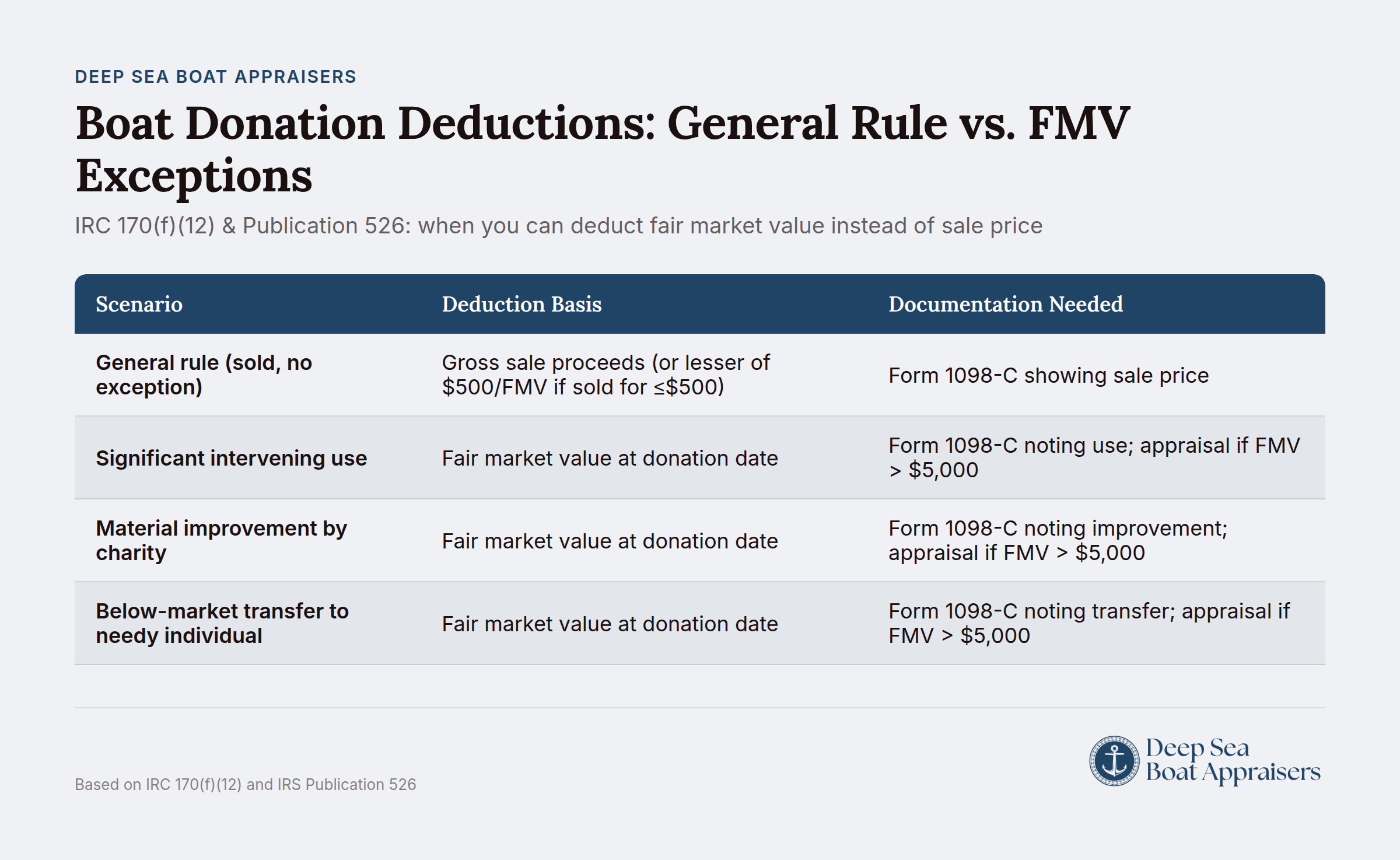
| Scenario | Deduction Basis | Documentation Needed |
|---|---|---|
| General rule (sold, no exception) | Gross sale proceeds (or lesser of $500/FMV if sold for $500 or less) | Form 1098-C showing sale price |
| Significant intervening use | Fair market value at donation | Form 1098-C noting use; qualified appraisal if FMV exceeds $5,000 |
| Material improvement by charity | Fair market value at donation | Form 1098-C noting improvement; qualified appraisal if FMV exceeds $5,000 |
| Below-market transfer to needy individual | Fair market value at donation | Form 1098-C noting the transfer; qualified appraisal if FMV exceeds $5,000 |
Worked Example: Same Boat, Three Different Outcomes
Numbers make this concrete. Suppose you donate a 28-foot sailboat with a documented FMV of $12,000 at the time of the gift.
Scenario A, general rule: The charity lists the boat for sale and sells it four months later for $7,500. Because no exception applies, your deduction is capped at $7,500, the gross proceeds, even though the boat appraised for $12,000.
Scenario B, significant intervening use: Instead of selling it right away, the charity uses the sailboat for six months in its youth sailing instruction program before eventually selling it. Because the charity put the boat to significant intervening use in furtherance of its mission, you can deduct the full $12,000 FMV, supported by a qualified appraisal.
Scenario C, the $500 rule: A smaller runabout with an FMV of $600 gets sold at a fundraiser auction for $350. Since the sale price is $500 or less, you deduct the smaller of $500 or FMV. Here that's $500, not the $350 sale price and not the full $600 FMV.
Form 8283 and the $5,000 Qualified Appraisal Requirement
Any time your claimed FMV deduction for a boat exceeds $5,000, whether through one of the three exceptions or another category of noncash property, the IRS requires a qualified appraisal and a completed Section B of Form 8283, signed by the appraiser. The instructions specify that the appraisal must be conducted by a qualified appraiser and that the form itself carries the appraiser's declaration.
We treat Form 8283 as part of the appraisal deliverable itself, not a separate task you're left to handle. When we complete a boat donation appraisal, the USPAP-compliant report and the signed Section B of Form 8283 come together, so you're not scrambling to find someone to sign off after the fact. Boat appraisals for donation purposes are quoted as a fixed fee before work begins, with advanced, IRS-qualified reports starting at $295 for most vessels; complexity, documentation quality, and vessel type determine the final scope, never the boat's condition or value.
If you're still working out whether your donation clears the appraisal threshold at all, our guide on how much you can write off for donating a boat walks through the dollar-figure specifics in more detail.
Pro tip: Get the appraisal done before the donation closes, not after. FMV is measured as of the contribution date, and an appraisal completed weeks after the charity already sold the boat can't establish that date-of-gift value credibly.
Watch out: If the charity's Form 1098-C doesn't check the box for significant use, material improvement, or a below-market transfer, the IRS will treat your donation under the general gross-proceeds rule by default, regardless of what your own appraisal says.
Get the Valuation Right Before You Sign
The gap between a $500 deduction and a $12,000 deduction often comes down to two things: whether one of the three statutory exceptions genuinely applies, and whether you have a qualified appraisal that can stand behind the number on your return. Neither of those gets sorted out after the boat is already gone. If you're planning a boat donation and want the valuation done correctly from the start, request a boat donation appraisal before you hand over the keys.
This article is provided for general informational purposes only and does not constitute legal, tax, or financial advice. Readers should consult a qualified attorney or CPA regarding their specific circumstances.