
Blog
Donating a Boat Without a Title: What Documentation You Actually Need
A missing title does not automatically kill a boat donation, but the paperwork you need depends on your state, your hull's documentation status, and how the recipient charity plans to use the boat. This guide walks through every path to legal transfer and explains why a marine survey still matters for your tax deduction.
Losing a boat's title feels like a dead end, but it rarely is. Whether you can donate a boat without a title depends almost entirely on state law, not federal tax law: the IRS cares about substantiating your deduction, while your state's titling or wildlife agency controls whether ownership can legally transfer. Here is how to sort out which situation applies to your boat and what to do about it.
When a Missing Title Is (and Isn't) a Problem
A missing title is a state-law transfer issue first, and a tax-documentation issue second. There is no blanket federal rule that lets you donate a boat "without a title": whether the charity can legally accept and resell your boat depends on whether your state requires a title for that class of vessel, and if so, whether you can obtain a replacement.
As reporting on vehicle and boat donations without a title notes, acceptance is controlled state by state, and a charity's willingness to take boats without titles never overrides a state's registration or lien laws. Sorting out your documentation path starts with knowing which of four situations you are actually in.
Titled States vs. Registration-Only States: Why It Matters
Some states issue a formal certificate of title for boats above a certain length or horsepower, much like a car title. Others only issue a registration certificate and never title small or older vessels at all. The distinction matters because it determines what "replacing" your lost paperwork actually looks like.
- Titled states: If your state titles boats, a lost title is replaced through the same state agency (often the DMV, but sometimes a wildlife or natural resources department) using a duplicate-title application.
- Registration-only states: If your state never issued a title for your boat, a registration certificate, prior bill of sale, or manufacturer's certificate of origin can serve as ownership evidence instead, since there is no title to lose in the first place.
- Documented vessels: Larger commercial or recreational vessels may be documented with the U.S. Coast Guard instead of titled by a state at all, which follows its own replacement process.
Watch out: Don't assume your state's rule matches a neighboring state's. Boat titling requirements vary widely, and a boat that never needed a title in one state may need one the moment it is sold or donated across a state line.
How to Get a Duplicate or Replacement Title
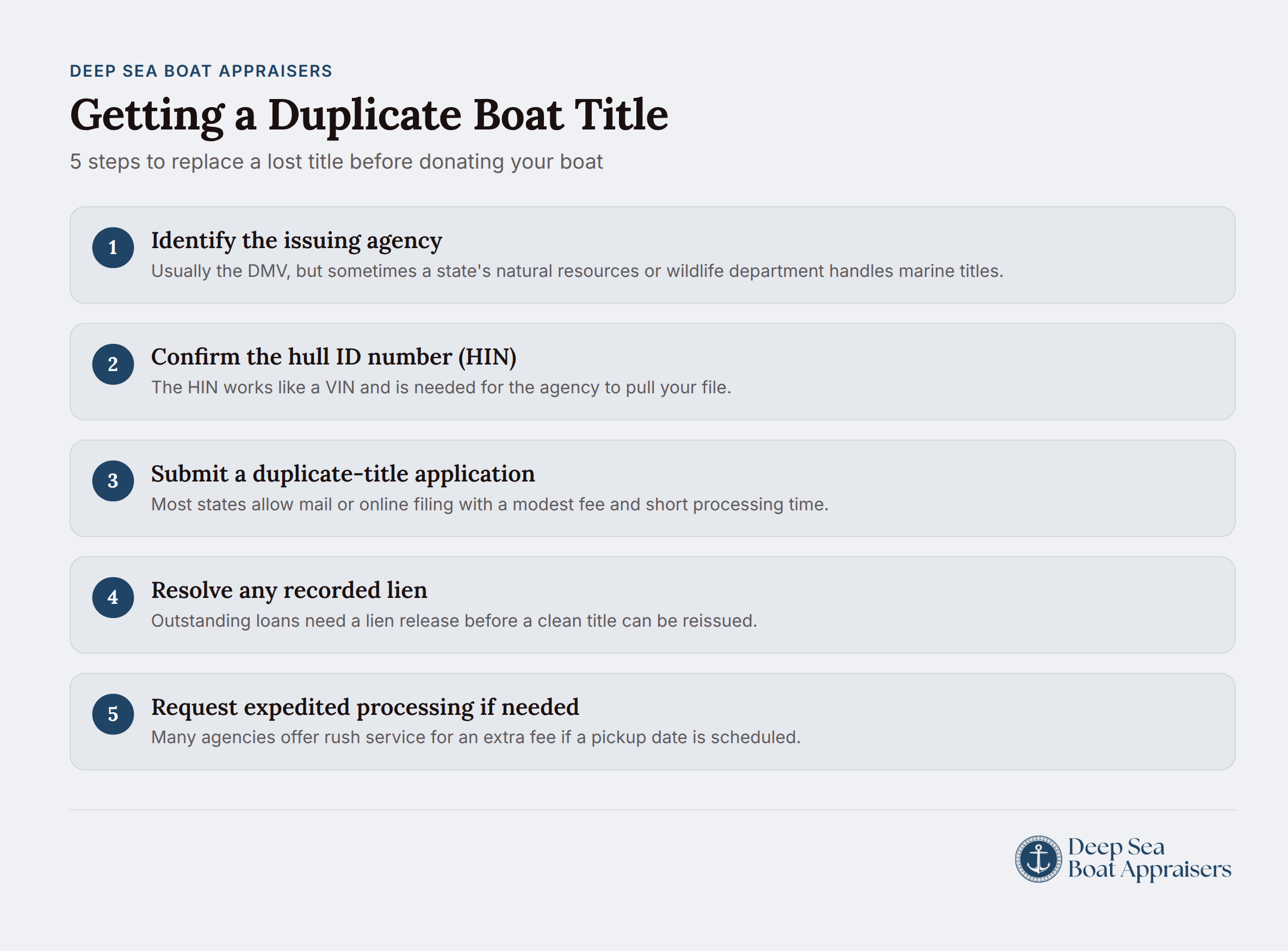
If your state titles boats, the fastest fix is almost always a duplicate-title request through the same agency that issued the original.
- Identify the issuing agency. This is usually the state DMV, but in many states it is the department of natural resources, wildlife, or motor vehicles division that handles marine titles specifically.
- Confirm the hull identification number (HIN). The HIN functions like a vehicle identification number for tax and transfer records, and the agency will need it to pull your file.
- Submit a duplicate-title application. Most states process this by mail or online, with a modest fee and a short processing window.
- Resolve any recorded lien first. A charity generally cannot sell or retitle a boat with an open lien, so any outstanding loan needs a lien release before the title reissues clean.
- Request expedited processing if the charity has a pickup date scheduled. Many agencies offer rush service for an added fee.
When a Notarized Bill of Sale or Lost-Title Affidavit Works
When a duplicate title isn't practical or your state doesn't title that class of boat, a notarized bill of sale or a lost-title affidavit can sometimes substitute. This works when the recipient charity's state accepts alternative ownership evidence and no lien is recorded against the vessel.
A lost-title affidavit is a sworn statement, usually on a state-provided form, declaring that you are the rightful owner and that the original title is lost, destroyed, or was never issued. A notarized bill of sale documenting the original purchase, paired with your registration history, often fills the same gap. Neither document overrides a state requirement for a formal title, so confirm with the recipient charity's state before relying on either one.
Example: A donor in a registration-only state has a 1998 center console with no title on record, only a registration renewal notice. A notarized bill of sale from the original dealer purchase, along with the current registration, is typically enough for the charity to accept and resell the boat.
Documented Vessels: U.S. Coast Guard Certificate of Documentation
If your boat carries a Certificate of Documentation from the U.S. Coast Guard rather than a state title, replacement runs through the National Vessel Documentation Center instead of a state agency. Documented vessels are generally larger recreational or commercial boats that opted into federal documentation for financing, insurance, or interstate operation purposes.
A lost or damaged Certificate of Documentation is replaced using the National Vessel Documentation Center's abstract and replacement request process, commonly filed as Form CG-1258. The process confirms the vessel's official number, verifies there are no unresolved liens in the Coast Guard's records, and reissues a current certificate before the boat can transfer to a new owner, including a charity.
Pro tip: If you're not sure whether your boat is state-titled or federally documented, check the hull for an official number stamped near the HIN. A documented vessel carries a Coast Guard official number in addition to its HIN.
What If the Paperwork Is Missing Entirely?
If you have no title, no registration, and no bill of sale, you still have options, but they take longer. Reconstructing ownership proof generally involves piecing together whatever indirect evidence exists.
- Prior insurance records: An insurance policy or claim naming you as the owner, with the HIN listed, can support an ownership affidavit.
- Marina or storage contracts: Slip rental agreements or dry-storage contracts in your name over multiple years help establish continuous possession.
- Purchase records: Bank statements, canceled checks, or loan payoff letters tied to the boat's purchase can substitute for a missing bill of sale.
- A sworn ownership affidavit: Many states allow a notarized statement of ownership when no other documentation survives, sometimes paired with a waiting period during which any competing claim can surface.
This path is slower and not guaranteed to satisfy every state agency or every recipient charity, so start it well before any donation deadline you're working against.
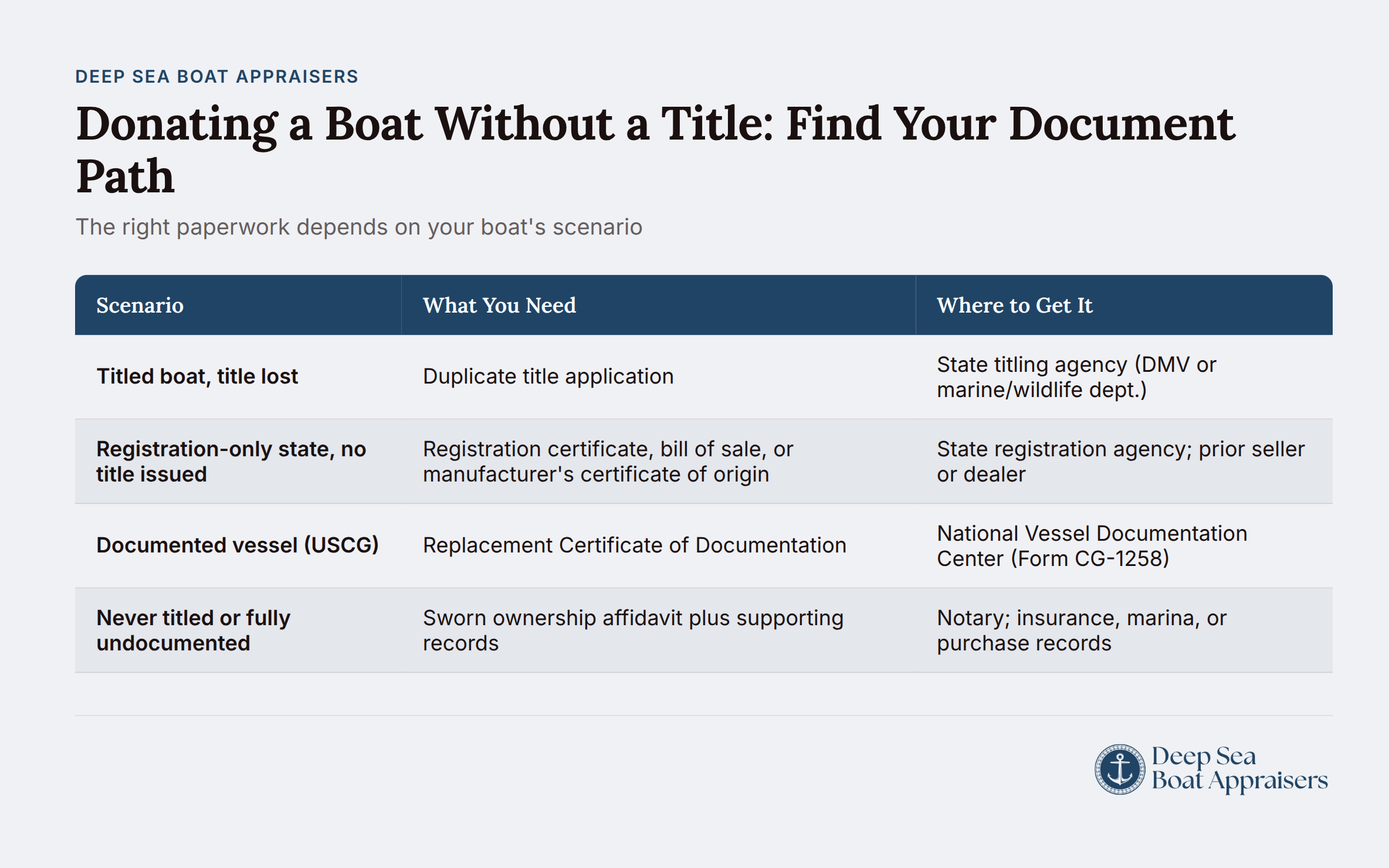
Document Path by Scenario: A Quick Reference
The right next step depends entirely on which of these four situations describes your boat.
| Scenario | What You Need | Where to Get It |
|---|---|---|
| Titled boat, title lost | Duplicate title application | State titling agency (DMV or marine/wildlife department) |
| Registration-only state, no title ever issued | Registration certificate, bill of sale, or manufacturer's certificate of origin | State registration agency; prior seller or dealer |
| Documented vessel (USCG) | Replacement Certificate of Documentation | National Vessel Documentation Center (Form CG-1258) |
| Never titled or fully undocumented | Sworn ownership affidavit plus supporting records | Notary; insurance, marina, or purchase records |
IRS Form 1098-C and the Deduction Rules That Follow Title Status
Getting the title sorted out is a separate question from what you can deduct, and the two rarely line up the way donors expect. For a claimed value of $500 or less, the charity generally does not need to file Form 1098-C, though you still need records supporting the contribution.
Above $500, the charity must file Form 1098-C and give you a copy or an equivalent written acknowledgment, and the IRS instructions for Form 1098-C require you to attach that copy to your tax return to claim the deduction at all. Under Internal Revenue Code Section 170(f)(12), most boat donations are limited to the charity's gross proceeds from selling the boat, not your estimate of its fair market value. We cover the mechanics of that gross-proceeds limitation, and how Form 1098-C documents it, in our detailed guide to Form 1098-C for boat donors.
There are two recognized exceptions that let you claim fair market value instead of gross proceeds. As outlined in general industry guidance on boat donation tax rules, the exceptions apply when the charity makes significant intervening use of the boat before any sale, or when it materially improves the boat prior to sale. Both exceptions require the charity's written certification, and neither one is something a donor can claim unilaterally.
Why an Appraisal Still Matters, Title or No Title
A sorted-out title has nothing to do with whether you need a qualified appraisal. Once your claimed deduction exceeds $5,000, the IRS requirement to substantiate charitable contributions of donated property calls for a qualified appraisal and a completed Section B of Form 8283, separate from anything the charity files.
Boats are treated differently from most other donated property because condition drives value so heavily. IRS Publication 526 specifically notes that, except for inexpensive small boats, valuation should be based on an appraisal by a marine surveyor rather than a used-boat pricing guide. Our marine survey and appraisal service establishes a defensible fair market value using the same documentation standards, regardless of whether your title is in hand, replaced, or reconstructed from affidavits.
Our boat appraisal fee is quoted as a fixed price after we scope your vessel, with standard reports starting at $195 and IRS-qualified reports starting at $295; more complex vessels or documentation gaps can move the fee higher, since the fee reflects the depth of research and reporting required, not the boat's value. Key takeaway: a clean title makes the charity's job easier, but it is the appraisal, not the title, that supports your tax deduction.
If you're still assembling documentation, our boat valuation FAQ walks through what our appraisers need from you before scheduling a survey.
Getting Your Boat Ready for Donation
A missing title slows a boat donation down, but it rarely stops one outright. Work the state-titling question first, since that determines whether the charity can legally take possession, and then separately line up the qualified appraisal your tax return will need if your deduction exceeds $5,000. The two tracks run in parallel, and starting both early gives you room to fix a lien, request a duplicate title, or gather affidavits without missing a giving deadline.
Our appraisers regularly work with donors who are still sorting out title paperwork, and we can begin the marine survey while you finish that process. Request a boat donation appraisal to get a fixed-fee quote and a USPAP-compliant report ready for your Form 8283.
This article is provided for general informational purposes only and does not constitute legal, tax, or financial advice. Readers should consult a qualified attorney or CPA regarding their specific circumstances.